
Business owners often ask me what they should be doing if they want to sell their business in the next couple of years.
It’s a sensible question, but I don’t think it’s the right place to start.
The businesses that achieve the strongest outcomes are very rarely transformed in the final eighteen months before a sale.
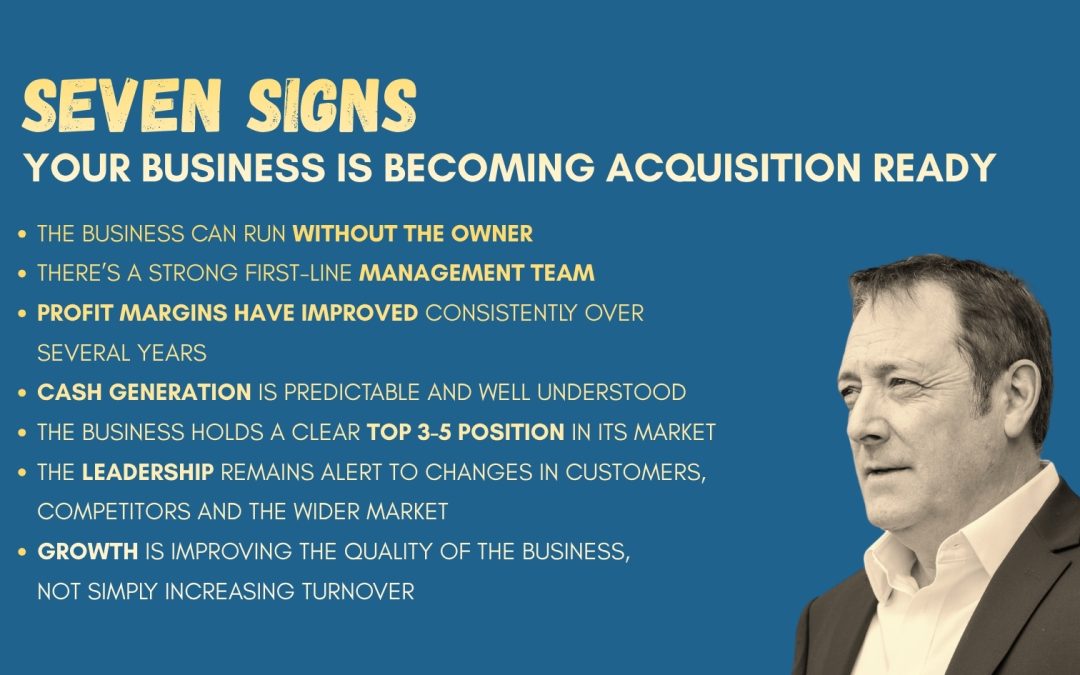
By that stage, most of the really important work should already have been done by then. Leadership has been strengthened, reporting has become more disciplined, profitability has dramatically improved and the business has learned to operate without relying on one individual for every important decision.
In other words, acquisition readiness isn’t something you suddenly decide to create. It’s something that’s been building for years.
That’s one of the biggest misconceptions I come across. Owners often believe buyers are mainly interested in turnover, market share or the latest set of accounts. Those things are obviously important, but they don’t tell the whole story. Long before I start analysing financial information, I’m looking at how the business operates, how the owner thinks and whether the organisation feels capable of sustaining its success long after the founder has stepped away.Businesses always leave clues as to what they ‘really’ are as opposed to what a sales sheet says it is!!
The quality of the management team tells me a huge amount. So does the way the owner talks about their customers, competitors and the future. You can usually tell within a relatively short conversation whether someone is still curious about their market or whether they’ve become comfortable with what has worked in the past.
I’ve often described this as falling into the velvet rut. Nothing appears obviously wrong. Customers are still buying, people are busy and the business is still making money. But underneath the surface, competitors are improving, markets are shifting and customer expectations are changing. The business isn’t standing still because anyone intends it to. It’s standing still because success has become familiar.
By the time the numbers begin to reflect that, buyers have often spotted it already.
One of the clearest indicators that a business is becoming genuinely attractive is when the owner is no longer the centre of everything. That doesn’t mean becoming less interested or less committed. It means building a business that’s capable of making decisions, looking after customers and continuing to grow without one person carrying the entire organisation.
Ironically, many founders see their constant involvement as one of the business’s greatest strengths. Buyers often see it as one of the biggest risks.
The same principle applies to profitability. I’ve lost count of the number of conversations where owners proudly explain how turnover has grown over recent years. It’s always encouraging to see a business expanding, but growth on its own doesn’t necessarily create value. What interests experienced buyers is the quality of that growth. Are margins improving? Is cash generation becoming more predictable? Has the business become stronger, or simply become bigger?
Those are very different questions, and they usually lead to very different valuations.